This is Epilogue 2 for my book. In your imagination, add it to the Myth of the Yellow Kitchen as another chapter about life, work, pleasure and complexity. Learning goes on forever—in seven days I learned about hardship, kindness, new cultures, the technology and magnitude of the 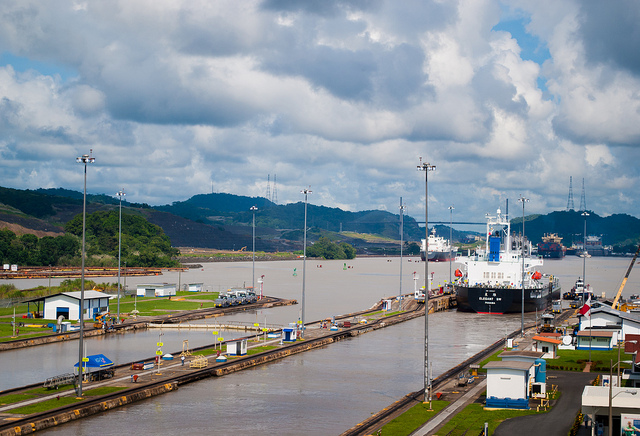 Canal and something about the sea. I could go on and on, but take the trip yourself, and, don’t forget, read my book.
With some friends, I planned a trip in early January to Costa Rica and the Panama Canal, a recreational trip, a trip to get away from the bitter, January Boston weather. Boston was 2 degrees during the day and below zero at night. What a time to get away. I hadn’t been away for a long time and really forgotten what it was like to see new places, taste new foods, experience new cultures, and meet people. We live on a large planet and there are so many cultures and differences. On some level everyone is the same, they are born, grow up, marry, have children, work, and age. But different people do it in different ways. And that is intriguing.
The ship, The Variety Voyager, was small by general cruise standards with only seventy passengers, generally two to a cabin. This Greek vessel had almost everything you could want on a vacation including appetizing food, spotless, comfortable and beautifully appointed cabins, a gym, cheerful and helpful staff, and great trips on land.
People are Different and Yet the Same
 We began in Costa Rica with one night at the magnificent Radisson Hotel. And then from the ship, we sampled the city of San Jose, the wonderful, pristine beaches, nature trails, animals, birds, fish, the special food of Costa Rica. On one unspoiled beach, we snorkeled in the calm, clear water. The staff provided barbecues, although how they do it is a mystery to me. How do they carry all that food and everything else that goes with a meal? Everywhere we met gentle and kind people.
When I travel to a different culture I learn what is different, what is the same. Here in Costa Rica, there is no army, but people live in houses guarded by heavy chain link fences. When we got lost, a family asked us in. They gave us tea and told us how to get where we had intended to go. I was charmed by their hospitality. Would this happen in America? They are not afraid. But the chain link fence is strongly locked. Contradictions that I perceive and do not understand intrigue me.
Ingenuity of People Amazes
The nights were wondrous as the ship moved gently through the Pacific. On only two nights the ship rocked with the current and the waves. There was music at night by a wonderful staff member from Serbia who can play classical music, pop, jazz and a million songs that we sing together. Where did he learn this? He did not begin studying music until he was seventeen. The ingenuity of people amazes me. We, the Americans, are not wealthy but rich enough to be on this ship and have our children study music at an early age. I marvel at the staff, their lives are difficult, but they smile, are gracious and play the most wonderful music with joy and passion.
The Panama Canal
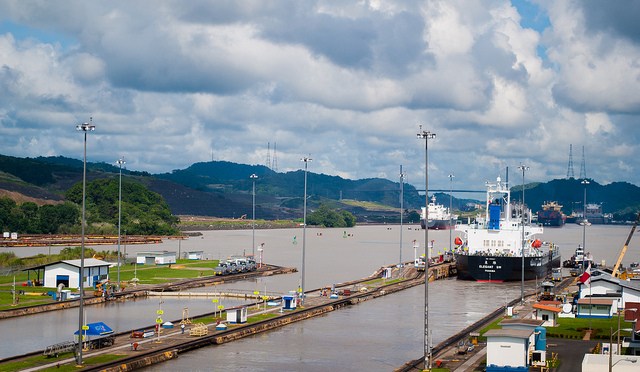
And then we reached what we all came for—The Panama Canal. It cost $17,000 for the ship to pass through it at night. We crowded the front deck as we watched the ship move through the four locks, pulled by small trucks called mules. Mules are what pulled the ships when the Canal was built in 1914. How did they do it then, there was no technology? The trip through the Canal takes eight hours and the hardy few of us stayed to see us go through the last lock at 1:30 a.m. How many times in school did I study the Panama Canal? But I never could imagine, its largesse, the man-made lakes that feed it, the work crews, the locks. Who were these people that envisioned this feat in 1914? So much to know and to learn.
A Diverse Staff
One night, the Captain Andreas Sifnotis told us about his life. He is Greek and met his wife when they were both young and working on a ship. The sea is his life. He explained nautical terms, what he is responsible for and what makes a ship go. He was telling us not just about the ship but about the layers of life, of pleasure and work. The staff comes from many places, Greece, Serbia, the Island of Mauritius, the Philippines, Indonesia and Egypt. Some come for the love of the sea, others for work. A few have not been home for years but send money home. The crew includes four young girls from Indonesia who arrived just a month ago. They are struggling to learn English but are always kind and helpful.
From Cruise Ship to Canoes
On the last day, we went by man-made wooden canoes to visit a tribe in the rain forest. The bus took two hours, the canoe ride through the rain forest another hour. Upon arrival, we were welcomed by twenty-eight families living in the rain forest, wearing loin clothes, dyes and tattoos. The women do not cover their breasts. They live on dirt. I wonder how come there is no grass here in the middle of the rain forest. We eat fish they have caught and some herb they have grown wrapped in a coconut leaf. They dance to homemade instruments. Their arts are all around us, for sale, ranging in price from $10.00 to over $500.00. And here is yet another contradiction. These are seemingly primitive people but they know about money and American dollars.
 Rhoada Wald