Category Archives: Thoughts on Life

Weeping

Can writing words wipe away the sadness? Can reading them help with the healing? We have to at least try.

I am wondering why I don’t

          write poetry

          Since my son died.

          My heart

          is a wasteland

          of weariness

          Can I weather

          the frozen mind.

Like a strong wind

that suddenly stops

My grief is woven

in between the heart

and mind. 

Will the writing ever work

again.

No longer weary

with the weight of sadness.

Will the weeping ever cease?

Celebrations Remembered

Birthdays, Bar Mitzvahs, and Bat Mitzvahs stand out across time, each reflecting life as it was then, feeling so permanent in the moment yet always changing. The shifts that blurred across the days, weeks, and years now look so clear in retrospect.

As I recall them here, they tumble one into the other, each representing their own sort of joy even in the midst of heartache.

The first birthday party I remember I was six years old.  My father was making a 30th birthday party for my mother; he was thirty-two.  I remember thinking how old they were.  My parents had a terrible marriage but I would like to believe that, at least once, she was grateful and happy and expressed those feelings to my father, who was always trying to please her.  Eventually, of course, he stopped trying to please and just left.

The next birthday I remember was my brother Marvin’s.  It was his Bar Mitzvah.    At thirteen, he was already grown, tall, handsome, and already shaving. He had those good-looking Hollywood playboy looks.  The ritual and the party afterwards were symbols of the culture we were part of rather than any deep religious significance.  Marvin was a boy, their first boy, and something to be joyous about.  I was five and my sister four when Marvin was born, and I still remember my father calling everyone and shouting, “It’s a boy, it’s a boy.  Finally, we have a boy.”

Only girls attended my sweet sixteen birthday party.  I sometimes get it confused with my bridal shower; one of them was at Tavern on the Green in New York.  I was chubby then and not very joyful about anything.  I was anything but sweet, good, yes, but definitely not sweet.

And then there were all the yearly parties for my children, Marian, Stephen and Beth.   There were those endless parties in the living room.  Once I hired a teenage clown.  There were story telling parties and scavenger hunts.  We even had parties at a local park with barbecues and baseball for Steve.  If we were lucky enough to avoid a party, we would take one or two friends of the birthday child to some special event instead. 

When my youngest, Beth, was about five, the neighbor across the street had a party for her five year old.   She invited everyone on the block except Beth.  The next summer I invited her daughter to Beth’s party and she felt very uncomfortable and guilty, at least that is what she expressed to another neighbor.  Good, that was just what I wanted to happen.

Then came those surprise parties my friends and I made for each of our forty-year old husbands.  I thought the one I made for Charly was very successful.  But, shortly after the party, he asked me for a divorce.  The same thing happened to quite a few of my friends who had similar parties for their husbands’ fortieth birthdays.   From then on, we advised everyone we knew who was contemplating such a party against it.  We warned people that those parties were the kiss of death and were a prelude to middle age angst.

Marian was Bat Mitzvah and Steve Bah Mitzvah in the same synagogue a year apart.  We were divorced by then and all I could afford was a party afterwards in my home.  Charly forbade any of his family from coming.  We kept a stiff upper lip about it all but it surely was a symbol of the legacy of divorce and very sad.

By the time Beth was sweet sixteen, Charly was remarried and living in a lavish home in a neighboring community.  He planned a formal party for Beth at his house.  Beth and I had so much fun buying her first formal dress.  And he was gracious, he invited us all, some of my friends, and even my mother and her second husband.  As soon as I walked into the house Charly told me how many bedrooms and bathrooms his grand new house had.  It was big, but very tacky.  He had no idea how I might feel seeing this house while I received hardly any alimony and child support.  The neighbors complained about the music from the live band and the dancing had to stop.  Later that night, Beth and most of her friends and Charley’s stepsons ended up on my living room floor spending the night.

My birthday, November 26th, always falls sometime on the Thanksgiving weekend and everyone came home no matter where they lived.  When I was sixty, my children made me a surprise birthday party.  I can still feel how stunned I was at one Thanksgiving when I opened the card to find the picture of a computer.  What I appreciated was their image of me.   So many of the people I know are snow birds, or blue birds, or goofy birds.  But my children think of me as this busy person uncovering new worlds via the internet and wide world web which is a gift in itself. 

Another time, my family gave me an expensive music system.  My family surprised me with a party when I was sixty, gave me a new computer when I was seventy, and a music system when I was seventy-five.  I could hardly wait for what I would get when I became eighty.  Perhaps they would think of a new car, an airplane, who knows what.

The Spaces of My Soul

No matter how big the house, there’s one room where it seems everyone ends up. The kitchen. Big or small, it’s where people naturally gather. Maybe it’s because it’s the source of the food. Maybe it’s because we have so much in common there. Regardless, a full kitchen is a happy place. And even when I’m on my own, I find it’s where I want to be.

My kitchen is my home

The best light to read with

A table to eat and write on

Food near me

The telephone a step or two away.

I hardly cook

Even in my kitchen.

Easy access to the tidbits, snacks

and wholly fattening things.

The kitchen is my home

Calm, peaceful, solid.

Reading the morning newspapers

Writing a story

Answering the telephone.

In the kitchen

I live my life

With almost everything I need.

The New York Times, The Globe

And the book I may be reading

Alone, my life, my heart,

Live on and on

In this small space.

The kitchen.

Shadows of My Life

The shadows of my life stream by


The lights and darks of my old ties


Blacks and whites, they seem to last


Beyond the strum and stress and cries.


The pain and triumphs of the past


The house I thought was warm and vast


Now small and simple and so dim


Shadows that are hard to grasp.


These shadows shape my dreams of him


What was true and what was sin


But shadows fade and then unfold


It’s time to let new life begin.


Which shadows should I keep and hold


What stories should I let be told


I grasp the new becoming bold


I grasp the new becoming bold.


As Time Goes By – The Mystery of Aging

Bits and Pieces of Being Older

 Suddenly, at least it seems suddenly, I am a member of a new generation, an older generation who is living longer, longer than my grandparents, longer than my mother and father, longer than anyone I ever knew, even longer than my younger siblings. 

I don’t really feel old, whatever feeling old means. To me it is a great big mystery.  Before this time of life, I had many roles, a wife, a career, a parent, a friend.  There doesn’t seem to be any rules or roles for this stage of life.  Some people believe older people have wisdom.  But what is wisdom?  Is it simply living longer that makes one wise?

I have more questions than answers.

What is ageism?  It is the descriptor that chronological age is what it is all about and that this stage of life is about decline and loss.  It is not the truth, it is a stereotype because people of any age are different from one another.  Like sexism and racism, ageism is prejudice. 

Am I Growing Old?

Now, I am walking seventy laps rather than one hundred.  I swim thirty laps when I used to swim seventy.  Should I keep trying to keep up with the earlier days?  Growing older means thinking about mortality, my mortality, and that is so difficult.

I decided to make a Rosh Hashanah dinner again.  So many people are not here, Kay and Don, Hy and Sheila and we will miss them.  I have done it for at least forty years.  This year Rosh Hashanah was a bit different because some of the people who came every year did not and people who had never joined us before came.  It was wonderful, the feelings of community, of different generations talking together.  We talked about hope and the problems of our country.  I know I won’t be here in ten years so I might as well do it now.  Everyone loved being here together but we missed the ones who were not. 

Two grandchildren are getting married next year.  Will I make it?  Will I dance at their weddings? 

A New Horizon

What is ageism?  It is the descriptor that chronological age is what it is all about and that this stage of life is about decline and loss.  It is not the truth, it is a stereotype because people of any age are different from one another.  Like sexism and racism, ageism is prejudice.       

Each morning I get up and think, “well what will it be today?”  What new adventure?  What part of my body will echo the years gone past, the running, swimming, and long hikes?  

At this stage of life, there is so much freedom—to do whatever I want to do and can afford, to go to the movies, meet friends for dinner, join a club, a group, a class, teach a class.  My options are infinite; I just have to imagine what I want to do. what I can do.  This is the last phase, I will try to do my best.

Solitary Confinement


1

For me, solitary confinement began on March 20th, 2020.  That is almost two years ago.  March 20th was the time we really began to absorb the fact that we were in a worldwide crisis.  A new and strange virus was circulating in the world, people were dying everywhere, particularly people over sixty.

My apartment was the best place for me.  I had all my things, I could write, I could be involved in the HILR and Temple programs on zoom.  And this could not last forever.  We were wrong.  It is now January 2022 and we really don’t know how long it will last.  The second variant has evolved and who knows if there will be a third or a fourth or even a fifth, ad infinitum.

I heard on the news today that a new variant, a third, is appearing in Europe.

On one level, you get used to it.  At least I did.  I am not depressed.  But there is a melancholy I feel, I am at the later stages of life.  Do I have any power or control over what I wanted this last stage of life to be?  Does anyone? 

In 2021, two new babies were born into our family–Noah and Killian.  But their parents, my grandchildren, are careful, rightfully so.  But how do I feel?  Estranged in a very deep and personal way.  I have seen both.  Noah several times and Killian once.  I can’t go to their homes, see their weekly changes and growth and rejoice in the longevity I have and the expansion of my family from four of us, my three children, and me to, now, almost twenty.  I respect my grandchildren for the protection of their families, their newborn babies.  But I miss the old way.  Will it ever go back to normal? 

2

Besides my family and me, there is the rest of America and the rest of the world.  Will we recover?  What price will we pay for this long siege?  What price will I pay? 

My food habits have almost gone berserk.  I ate three popsicles yesterday.  Today, I will try and limit myself to two.  Two months ago, I lost eleven pounds, I had some kind of illness.  Two weeks later I gained back the eleven pounds and now again, I need to watch what I eat.  Solitary confinement is a great setting for eating all the wrong things, not doing my exercises, and taking my daily shower at three in the afternoon instead of in the morning. 

When I was young with three small children, I was often at home for several days.  One or more of the children was ill and I was the mother, nurse, maid, and wife.  The good wife that I was, I picked up the toys before Charly came home.  After a long day’s work, it was better to come to a neat home with quiet children and no toys all over the living and dining rooms.  That was a difficult time for me, but I never thought of it as solitary confinement but it was in a way.

Yesterday it snowed all day.  Today I dressed warmly, put on all the right clothes including boots, and went out for a walk.  Oh, to breathe that nice clear air.  But the streets were dangerous, places I had to walk carefully because they had not cleaned the snow and they were very slippery.  Back home to solitary confinement.

3

I watched the Australian tennis final this morning, I love Nadal.  I have watched him since he was a young player, nineteen I think, with a long ponytail.  My son watched it at 3:30 a.m. and he told me the results.  Everyone thinks that is crazy but I love watching tennis.  I don’t need the tension to appreciate it.

I took several literature courses with Bob Steinberg at HILR.  He died several years ago.  At the first session of one of his courses, he showed us how he always read the last few pages first.  And I have learned to do that too, it allows me the freedom to enjoy what I am reading without unnecessary tension.

So here I am in solitary confinement rambling on about lots of things that may have nothing to do with being so alone.  But then, what does someone do in this kind of setting.  How do people in jail sustain the experience, some for years?  Do they ramble on?  What do they write on?  They surely don’t have computers. 

new-born babies.  But I miss the old way.  Will it ever go back to normal? 

4

Besides my family and me, there is the rest of America, and the rest of the world.  Will we recover?  What price will we pay for this long siege?  What price will I pay? 

My food habits have almost gone berserk.  I ate three popsicles yesterday.  Today, I will try and limit myself to two.  Two months ago, I lost eleven pounds, I had some kind of illness.  Two weeks later I gained back the eleven pounds and now again, I need to watch what I eat.  Solitary confinement is a great setting for eating all the wrong things, not doing my exercises, and taking my daily shower at three in the afternoon instead of in the morning. 

When I was young with three small children, I was often at home for several days.  One or more of the children was ill and I was the mother, nurse, maid, and wife.  The good wife that I was, I picked up the toys before Charly came home.  After a long day’s work, it was better to come to a neat home with quiet children and no toys all over the living and dining rooms.  That was a difficult time for me, but I never thought of it as solitary confinement but it was in a way.

Yesterday it snowed all day.  Today I dressed warmly, put on all the right clothes including boots, and went out for a walk.  Oh, to breathe that nice clear air.  But the streets were dangerous, places I had to walk carefully because they had not cleaned the snow and they were very slippery.  Back home to solitary confinement.

5

I watched the Australian tennis final this morning, I love Nadal.  I have watched him since he was a young player, nineteen I think, with a long ponytail.  My son watched it at 3:30 a.m. and he told me the results.  Everyone thinks that is crazy but I love watching tennis.  I don’t need the tension to appreciate it.

I took several literature courses with Bob Steinberg at HILR.  He died several years ago.  At the first session of one of his courses, he showed us how he always read the last few pages first.  And I have learned to do that too, it allows me the freedom to enjoy what I am reading without unnecessary tension.

So here I am in solitary confinement rambling on about lots of things that may have nothing to do with being so alone.  But then, what does someone do in this kind of setting.  How do people in jail sustain the experience, some for years?  Do they ramble on?  What do they write on?  They surely don’t have computers. 

Charly, my ex-husband, once had an internship in a jail and they had a visiting day.  I went.  I know people live in jails, but seeing the jail and the bars and the people in it is another experience.  How do they do it?  People watching everything they do.  And they do it for years.  And what about the people in solitary confinement.  They often cannot even see outside their cell.  How do they manage?

I am having trouble managing my solitary confinement in a beautiful apartment in a lovely building in Brookline.  Yesterday I watched the snow falling and it was surreal.  Do they ever see snow from their captivity in jails and solitary confinement?
I Am The Heart

from The House Loved Us…A Collection of Poems About Life and Loss

I am the heart

that beats for family

beats for women

beats for all

Sing a song of care

Let my heart beat loudly

when life tries to end that force.

I beat for those I love

I hear the cries

of people, men,

women, children

crying for their losses.

Let my heart not harden

against the people who

have hardened their

hearts against me.

I am the heart

Sometimes broken

by the weight

of misdeeds, of

cries that harbor

in the body of the heart.

I beat for those I love

who do the right thing

no matter the price

they pay.

I am the heart

one of many

conscious of the burden of people

everywhere.

Hear the wails of

broken marriages, loss

of family, the quiet

whimpers of the

sleeping child.

Sometimes no one hears me

no matter how strong

the heart beats.

I am the heart

joyous but

afflicted with

the sorrows of the world.

The heart is heavy,

burdened

I can’t do everything.

When my heart is broken

and weeps and weeps

but then revives itself

open, ready for the love

kindness, and generosity,

of nameless spirits.

World War II: Chaos and Order

This is part 2 of my recollections of World War II, a time of atrocities and resilience. These are things that should not be forgotten.

I remember those weeks we watched T.V. as the Allied forces liberated the concentration camps.  We could not believe what we saw, people so emaciated, they could not move, ovens where they had been cremated, rooms with crowds of people standing naked, thinking they were waiting for a shower.  Slowly, they were gassed.  It was unbelievable but real.  We could also see the faces of the Russian and American armies that liberated these camps.  They could not believe what they saw.  It was beyond everyone’s ability to imagine this level of cruelty and mass extermination.   

The newspapers and T.V. were also filled with stories about the Japanese, the camps they had for captured American soldiers.  John McCain, the hero, and later Senator, was severely tortured.  Who could watch such atrocities?

I was still going to college when I became a nurses’ aide.  I worked on the days I was not in school and on weekends.  We wore blue and white uniforms and I was assigned to St Luke’s Hospital on Morningside Drive and 112th St.  One of my first assignments was to help a woman clean up the blood on her body, her clothes, and the bed.  She had attempted to self-abort and this was a Catholic hospital.  Another day a woman had diarrhea all over the bed and I was assigned to clean up.  I did all these chores and many more.  And the nurses, all nuns wearing habits, were so compassionate and caring.  For me, this experience turned out to be more than a nurse’s assignment.  I learned much about life that I did know in my sheltered Jewish environment in the Bronx.

At this later stage of life, I don’t see films anymore about Nazis and what they did.  I really can’t bear it.  Although not religious in a theological sense, I feel strongly about retaining my Jewish identity.  I read about antisemitism but still don’t understand it.  Why do people hate others just because they are Jewish?  When I was first married, we were living in Washington, D.C. and I heard a man in People’s Drugstore say to someone else,” I won’t Jew you down.”  I was shocked.  I never heard that expression before.

Israel independence was announced by David Ben Gurion in May, 1948, much to the dismay of the Arab world in Israel.  The conflict between these two worlds is still going on.   But it became a haven for Jews all over the world, those who escaped death during the Nazi years, and many Arabic Jews who fled their countries, seeking a safe haven.

The historic perils of that time still live on.  In the obituary columns in the Boston Globe (July 11, 2021) and The New York Times (July 16, 2021) there were articles about “Esther Bejarano, 96: death camp survivor who fought antisemitism,” and “Esther Bejarano, Survivor Who Fought Hate with Hip-Hop, Dies at 96.”  Her parents and sister were killed.  She was inducted into forced labor and later joined the orchestra at Auschwitz-Birkenau.  They played as Jews were brought to the camp for extermination.  “We played with tears in our eyes,” she said in 2010 during an interview with the Associated Press.  

According to the articles, she married, had children, lived in Israel, and died in Germany where she was born.  Resilience was the order of the day and often astonishing. 

The impact of that time never seems to end.  Every now and then an article appears about the art and artifacts that were stolen from Jewish families and synagogues during the Holocaust.  The journeys of these highly regarded and expensive works of art were diverse and often ended up in various museums in Europe or peoples’ homes. What to do with them when discovered?  Often the original surviving owners would search for years for the art and archives that had been stolen from them during the Nazi period.  Many of the original family were dead or old and frail.  (Boston Globe, July 24, 2021). 

On April 15th, 2021, Boston celebrated Israeli Independence Day by lighting up a bridge in Boston with blue and white lights, the national colors of Israel.  Hundreds turn out every year for the celebration.

After this generation dies, who will remember the atrocities of this period in history?  Or will the impact of these atrocities remain forever?   Have we learned anything about avoiding such horrors?  Who knows? 

World War II: Some Memories Never Fade

On April 15th, 2021, Boston celebrated the 73rd anniversary of the Israeli Independence Day by lighting up a bridge in Boston with blue and white lights, the national colors of Israel.  Hundreds turn out every year for the celebration.

After this generation dies, who will remember the atrocities of the period in history that led up to the Independence?  Or will the impact of these atrocities remain forever?   Have we learned anything about avoiding such horrors?  Who knows? 

Here, I share some of what I remember about the 1940s when America was at war.

America was at war. Terrible things were happening in the 1940’s.  Pearl Harbor was bombed by the Japanese. Young men were drafted and many died.  Jews were being killed by the thousands, really millions, in Europe.  Gays and lesbians were also incarcerated. The Japanese were storming the South Pacific.  There was rationing of some foods, I don’t remember which ones.  Gas was also rationed.  In schools, children were practicing what to do in case of an air-raid.  Nazis from Germany invaded Russia, then called the Soviet Union, and many were killed in combat.  They did not anticipate what a Russian winter was like. 

I was fourteen when the war started, but it went on for several years.  At that time, I belonged to a group of young men and women, we called ourselves The Debites, after Eugene Debs, a famous socialist. All the boys were drafted into a branch of the American military.  I still remember our anguish when we found out that Robert had been killed.  He was our leader and so handsome.  How could a young man who had a life of such promise be killed in his twenties.

There was all the news about Jews in Europe being sent to concentration camps.  In my family, it was a constant topic of conversation.  We are Jewish, and lived in a Jewish neighborhood in the Bronx.

I remember my father signing some document so a particular family could come to America.  He signed many of them.  Someone asked him, “Can you really take care of all these people?”

 “They can take care of themselves, they just need to get out of Germany,” he said.  “But, if they need help, I will find a way.”

This was another side of my father that I never knew before.  He was in the sausage casings business and together, he and I, sent fourteen small salamis to men we knew overseas.  We did not know if they would get them.  And my father assured me they would be edible even though they travelled so many miles, by ship, overseas.  All the years of the war, we did the same thing, wrapping and sending a salami to every address we could find.  

When a friend of our family, Gene Schneider, came home, he thanked us for the salamis, and said “everyone loved them, we were so tired of military food, and they were always eaten in fifteen minutes.  We were so far away from home, but the salami, more than just food, reminded us that there was still such a place as the United States with good things to eat.”  Gene was eighteen when he went to New Guinea, he was stationed there for four years. We never heard of New Guinea until the war.     

Many of the Jewish people I knew came to the U.S. in the early years of the 19th century.  I don’t know why all my grandparents came, but my mother’s father came because he was going to be conscripted into the Russian army where Jews never knew how long they would be forced to serve.  For my grandfather, it meant forever.  He left Russia with a different name to avoid arrest.   

All these Jewish people, some I knew, and some I didn’t, were in anguish about what was happening to the Jewish people in Europe.  They came from different countries and for different reasons, but they understood anti-Semitism no matter the country or the form it took. 

Franklin Roosevelt was almost a God in the Jewish community in which we lived. The question of why Roosevelt did not accept the Jews and the ship, the St. Louis, has always been an open question and much has been written about it.  They were not accepted in any country, returned to Europe, where they were all killed. 

We lived in a two-family house.  One day, a few years later, there was this loud wail on the stairs coming from the second floor.  Mrs. Alexander was coming down the stairs to tell my mother “Roosevelt just died.”  Our community was in mourning.  There are no answers to some things that happen in life.  

(To be continued…)

Family History by the numbers

By Rhoada Wald, May, 2021

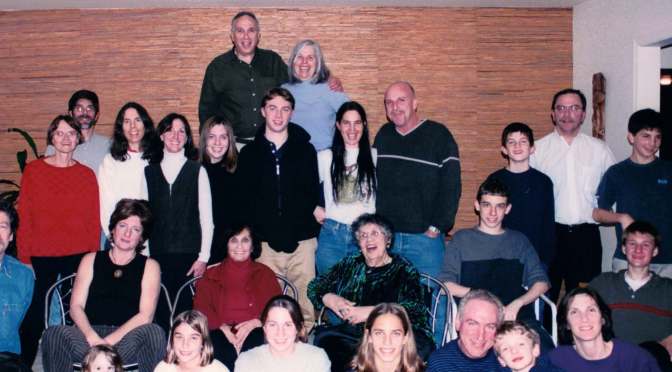
family photo

We were four

My children,

Marian, Stephen, Beth

and me.

But I really have to

count my former husband

He is family to my children.

          Actually, we were five.

Marian married George

and we were six.

Steve and Anne married

and we became seven.

When Beth married John,

we were eight.

Marian and George

had two children,

Todd and Justin.

Steve and Anne

had three,

Megan, Jonathan and Michael.

And Beth and John

had Jake. 

Two and three

and one are six.

Six and eight

are fourteen.

But now I remember,

Charly died two weeks

before Jake was born

In fact, we were only

thirteen.

          Jake was named

Jacob Charles in

memory of

his grandfather.

Justin married Jason

Todd married Marissa

Megan will soon

           marry Joe.

We became sixteen

Once we were four,

 really five

And now we are

almost seventeen.

I have three children,

Six with their spouses

Another six grandchildren

Three more by marriage.

Todd and Marissa added

one great grandchild.

Megan and Joe have

another on the way. 

Like flowers

new blossoms

form every day,

every year,

I hope forever.

And I am going

to stop counting.